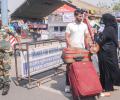
United States Charge d'Affaires Natalie Baker on Wednesday met Deputy Prime Minister and Foreign Minister Ishaq Dar as part of efforts to de-escalate tensions with India following the Pahalgam terror attack on April 22 in which 26 people were killed.

India reasserted that Pakistan requested a cessation of firing via DGMO contact and addressed concerns about Pakistan's roles in UNSC committees.
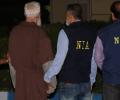
A Delhi court extended the judicial custody of Tahawwur Hussain Rana, accused in the 26/11 Mumbai terror attack, until August 13. The order was passed after Rana was produced via video conference. Rana is associated with David Coleman Headley. NIA has filed a supplementary chargesheet against Rana.

On Sunday, in the crucible of Dubai, it all comes down to a single question: Who will seize their moment and become a hero for a nation?
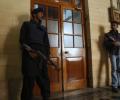
An armed guard of Qatal was also killed in the attack that took place on Saturday night.
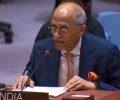
India strongly rejected Pakistan's 'unwarranted aspersions' over United Nations processes and attempts to deflect attention from atrocities committed against children in the country and rampant cross-border terrorism, asserting that the world has not forgotten the Pahalgam attacks.
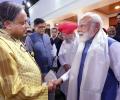
Prime Minister Narendra Modi's energy, dynamism and willingness to engage remains a 'prime asset' for India on the global stage but deserves greater backing, Congress MP Shashi Tharoor said on Monday, in remarks that are likely to irk his party and widen the growing cracks in his ties with its leadership.
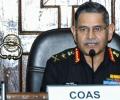
Indian army chief General Upendra Dwivedi on Saturday said that the surgical strikes carried out during Operation Sindoor were a clear message to Pakistan that supporters of terrorism will not be spared.
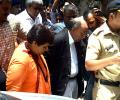
Unfortunately for the prosecution, the chassis number that the investigation was relying on to implicate Pragya failed as the court said in its judgment that the chassis number of the two-wheeler had been wiped out and therefore it could not be connected to Pragya.
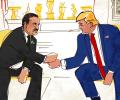
'Trump has personally weighed in to overcome doubts and reservations about Pakistan among his top advisors.'

Parts of Rahul Gandhi's speech during the Operation Sindoor discussion in the Lok Sabha were expunged from the record after he criticised the government for trying to protect Prime Minister Narendra Modi's image.
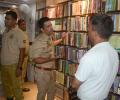
Bookstore owners were cautioned against keeping or distributing the books. Police personnel briefed the bookstore owners about the legal consequences of violating the ban.
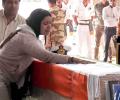
'Operation Sindoor is still ongoing. The Prime Minister himself said that blood and water cannot flow together, that talks and terrorism cannot go together. So how can we have a cricket match with a country that indulges in terrorism?'

Former Pakistan cricketers Shoaib Akhtar and Basit Ali's Youtube channels have been blocked in India following "an order from the government related to national security or public order" in the wake of the Pahalgam terror attack.

The entire impact of Trump's tariff policies over the last six months or so has taken the whole world back, and India too had a bit of a jolt just two to three days ago, Tharoor said.

The BJP accused Rahul of insulting the armed forces with his "surrender" barb at Prime Minister Narendra Modi.
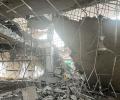
Indian Air Force S-400 Sudarshan Chakra air defence missile systems were fired last night against targets moving towards India. The targets were successfully neutralised in the operation multiple domain experts told ANI.

Investigations said the accused was engaged in sharing classified details, including troop deployments and strategic locations, posing a threat to national security.
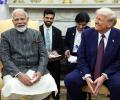
The lawmakers slammed opposition leaders over their remarks on the development, alleging that they were "happy" with the US government's move when "everyone" should be standing together in such a situation.
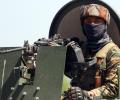
The real heroes of Operation Sindoor were not the armed forces or political leadership, but the ordinary citizens of India who refused to fall into the trap of communal provocation, asserts Colonel Anil A Athale (retd).
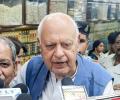
Terming Pakistan as a 'failed state', National Conference (NC) president Farooq Abdullah Thursday said relations between New Delhi and Islamabad would never improve until a peoples' government is elected in the neighbouring country.

The ministry of external affairs also seemed to reject Trump's forceful comments that Washington brokered the understanding between India and Pakistan on ending their four-day military conflict.

The court said the judiciary showing tolerance towards matters with anti-national overtones is leading to a rise in the number of such cases.
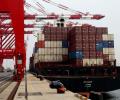
The crew of an Iraqi cargo vessel were denied permission to disembark at Karwar port in Karnataka by the coastal security authorities as per special instructions given by the central government "after the Pakistan incident", Karnataka Home Minister G Parameshwara said on Friday.
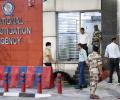
Tahawwur Hussain Rana, the mastermind behind the 2008 Mumbai terror attacks, has been taken into 18-day custody by the National Investigation Agency (NIA) in India. Rana was extradited from the United States after years of legal battles and will be questioned to unravel the complete conspiracy behind the attacks.
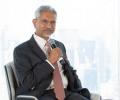
Jaishankar said that the Pahalgam attack "was an act of economic warfare. It was meant to destroy tourism in Kashmir, which was the mainstay of the economy. It was also meant to provoke religious violence because people were asked to identify their faith before they were killed."
She has been booked under the relevant sections of the Official Secrets Act and the Bharatiya Nyaya Sanhita, said the police.

Assam Chief Minister Himanta Biswa Sarma has accused Congress leader Gaurav Gogoi's British wife of collecting intelligence documents on behalf of the Pakistani climate lobby. Sarma claims to have documentary evidence of Gogoi and his wife's ties with Pakistan and will reveal everything publicly by September 10. Gogoi has denied the allegations, calling them a "C-grade Bollywood movie" and stating that he has only visited Pakistan once 12 years ago. Sarma alleges that Gogoi's wife, Elizabeth Colburn, worked for the climate lobby and had a close relationship with Pakistan.
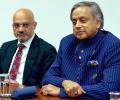
Tharoor said that though India's case might not be at the top of the agenda for the US media, India can get its message across easily.
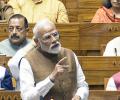
What was the aim of Operation Sindoor? Why was the operation halted so soon? asks Lieutenant General Prakash Katoch (retd).
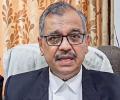
Noted lawyer Ujjwal Nikam, who is among four persons nominated to Rajya Sabha by President Droupadi Murmu, on Sunday said Prime Minister Narendra Modi called him to inform and spoke in Marathi.

Waiting for ministry confirmation, but good decision to give Pak the nod: Tirkey

Jasbir Singh, a resident of Village Mahlan in Rupnagar district, who operates a YouTube channel 'Jaan Mahal', was found to be associated with a Pakistani Intelligence Operative (PIO), Punjab Director General of Police Gaurav Yadav said.

Malhotra was among the 12 people arrested from Punjab, Haryana and Uttar Pradesh over the past two weeks on suspicion of espionage, with investigators suspecting the presence of a Pakistan-linked spy network operating in north India.
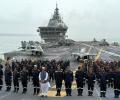
In an interaction with naval warriors on board aircraft carrier INS Vikrant off Goa, Singh sent a stern warning to Islamabad saying India will not hesitate to use the methods to deal with terrorism that Pakistan cannot even think of.

Pakistani intelligence operatives were allegedly developing Haryana YouTuber Jyoti Malhotra, who was arrested on espionage charges, as an asset, said a senior Haryana police officer on Sunday.
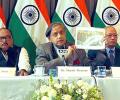
Tharoor also showed the picture of Pakistani Army officials attending the funerals of terrorists after India's strike on their terror bases.

Moody's Ratings on Tuesday cut India's GDP growth projections for 2025 to 6.3 per cent, from 6.5 per cent, saying economies globally will see a slowdown on account of heightened US policy uncertainty and trade restrictions.

'...it should not delude itself into thinking that India's security or its great-power ambitions will be advanced by those partnerships.'
'Instead, what India should focus on is on riding out the next three-and-a-half years of Trump's presidency with minimal damage to itself.'

BLA fighters reportedly took positions across the city, seizing control of the Levies and police stations, the deputy commissioner's office, a government guest house, and local bank branches.
